Quick Read
The ozone layer is one of the clearest modern examples of a global environmental condition whose trajectory has improved following coordinated international action. The Montreal Protocol and its amendments sharply reduced production and consumption of controlled ozone-depleting substances, and the abundance of major chlorine- and bromine-containing compounds in the atmosphere has been declining.
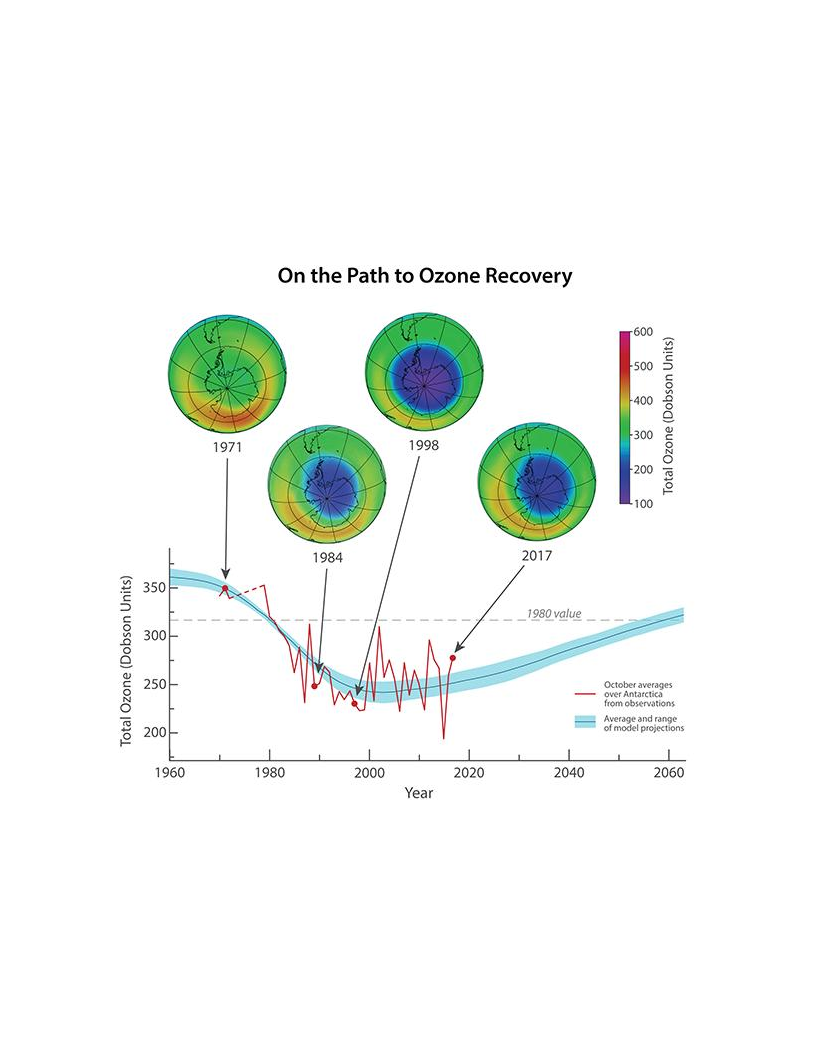
Recovery is not complete. Ozone-depleting substances can remain in the atmosphere for many decades, year-to-year Antarctic ozone-hole size varies substantially with weather and stratospheric conditions, and some ozone trends remain uncertain outside the upper stratosphere. The current evidence therefore supports "recovery underway," not "problem solved."
Condition vs. Response
Two timelines use the same time scale so the historical damage and measured recovery of the ozone layer can be compared with the international controls, monitoring and scientific work supporting that recovery.
1. Condition Timeline
Color represents broad condition states. Unlike many Observatory subjects, this condition has evidence-supported recovery windows, although those dates vary by region and depend on continued controls.
2. Response Timeline
Major response categories are shown against the same 2000–2106 viewing horizon. Bars indicate continuing work needed to sustain recovery.
Current Assessment
The response is working, and recovery is on track.
Scientific assessments conclude that actions under the Montreal Protocol have reduced ozone-depleting substances and are advancing recovery of the stratospheric ozone layer. The clearest recovery is seen in the upper stratosphere and in Antarctic springtime ozone, although natural variability and other atmospheric influences can temporarily strengthen or weaken the ozone hole from one year to the next.
What We Know
Stratospheric ozone absorbs much of the Sun's biologically damaging ultraviolet radiation. In the twentieth century, chlorofluorocarbons and other ozone-depleting substances released chlorine and bromine into the stratosphere, where they catalytically destroyed ozone.
The Montreal Protocol on Substances that Deplete the Ozone Layer was adopted in 1987 and subsequently strengthened through amendments and adjustments. WMO reports that more than 99 percent of the production and consumption of controlled ozone-depleting substances has been phased out.
The 2022 WMO/UNEP Scientific Assessment found unambiguous increases in upper stratospheric ozone during 2000–2020 outside the polar regions and continuing recovery of Antarctic total column ozone, although year-to-year variability remains large.
The same assessment projected return to 1980 total-column ozone values around 2040 for the near-global average, around 2045 for the Arctic and around 2066 for the Antarctic, assuming continued compliance with current controls.
What Could Change the Direction?
Continued compliance with the Montreal Protocol remains central. Recovery could be delayed by unexpected or unreported emissions of controlled chemicals, emissions associated with feedstocks or by-products, gaps in atmospheric monitoring, or other changes affecting stratospheric chemistry and circulation. Volcanic eruptions, major wildfires and climate-driven stratospheric changes can also temporarily influence ozone conditions.
What's Being Done?
Ozone protection combines international chemical controls, national implementation, atmospheric measurement, satellite observation, scientific assessment and continued development of lower-impact replacement technologies.
Montreal Protocol Controls
Parties to the Montreal Protocol phase out or tightly control production and consumption of major ozone-depleting substances. The agreement has been repeatedly strengthened as science and technology have advanced.
Atmospheric Monitoring
NOAA, NASA, WMO partners and national observing networks measure ozone and ozone-depleting chemicals using ground stations, balloons, aircraft and satellites.
Compliance & Emissions Detection
Atmospheric observations help identify unexpected emissions. Earlier detection of unexpected CFC-11 emissions demonstrated the importance of independent monitoring and international follow-up.
Replacement Technologies
Refrigeration, air conditioning, foams, fire protection and other industries have shifted away from many ozone-depleting chemicals. The Kigali Amendment also addresses high-global-warming-potential HFC substitutes.
Scientific Assessment
WMO and UNEP periodically assemble international scientific assessments to evaluate ozone trends, chemical abundances, recovery projections and new risks. The 2026 assessment is in preparation and is expected to be released near the end of 2026.
Who's Doing the Work?
Ozone recovery is the product of international coordination rather than one agency or one country. Science, regulation, industry transition and treaty compliance all contribute.
Alternatives & Solutions
Unlike conditions for which a solution remains largely theoretical, ozone protection already has a demonstrated global response system. The main task is to maintain and improve that system until long-lived ozone-depleting chemicals decline sufficiently for recovery to be completed.
Maintain Existing Controls
Continued compliance with phaseout schedules prevents renewed growth of controlled ozone-depleting chemicals.
Detect Unexpected Emissions
Expanded atmospheric monitoring can identify emissions that inventories or reporting systems fail to capture.
Manage Existing Chemical Banks
Ozone-depleting substances remain in old refrigeration systems, foams and other equipment. Responsible recovery and disposal can reduce future releases.
Improve Replacement Technologies
Replacement chemicals and technologies should protect ozone while also minimizing climate and other environmental impacts.
Barriers & Remaining Risks
The overall recovery trajectory is favorable, but several factors can slow or complicate progress. Continued success therefore depends on maintaining the institutions and measurements that produced the improvement.
Is It Working?
Observatory Assessment
Yes. The underlying condition is improving, although recovery is incomplete.
Controlled ozone-depleting substances are declining, upper-stratospheric ozone is increasing, and Antarctic ozone shows a long-term recovery signal despite substantial annual variability. This is strong evidence that the international response has altered the trajectory.
Observatory will continue to track whether atmospheric concentrations of ozone-depleting substances decline as expected, whether observed ozone recovery remains consistent with models, and whether projected recovery windows change as the 2026 and later scientific assessments are completed.
What You Can Do
The largest ozone-recovery gains have come from international policy and industrial transition rather than individual household behavior. Individuals can still support the result through responsible equipment handling, informed purchasing and attention to verified scientific information.
Maintain Equipment
Service refrigeration and air-conditioning equipment responsibly and use qualified technicians so refrigerants are recovered rather than released.
Dispose Responsibly
Use approved recycling or disposal programs for old refrigerators, freezers and air-conditioning equipment that may contain controlled refrigerants.
Check Refrigerant Choices
When equipment is replaced, consider current efficiency and refrigerant standards rather than relying on outdated ozone-depleting technologies.
Follow Official Measurements
Use NASA, NOAA, WMO and UNEP ozone observations and assessments rather than judging the long-term trend from one unusually large or small ozone hole.
Understand the Difference
Stratospheric ozone protects life from ultraviolet radiation. Ground-level ozone is a separate air-pollution problem; improvement in one does not mean the other has been solved.
Watch the Next Assessment
The WMO/UNEP 2026 Scientific Assessment is in preparation. Its final findings may refine recovery estimates and identify new challenges.
Last evidence review: August 16, 2026
What We Do Not Know
Recovery dates are projections rather than guarantees. They depend on future compliance, emissions, atmospheric chemistry, climate interactions and natural variability. The Antarctic ozone hole can still be large in an individual year even while the long-term trend improves.
Scientists also continue to investigate differences between upper- and lower-stratospheric ozone trends, unexpected emissions, changes in atmospheric circulation, wildfire and volcanic influences, and possible effects of future stratospheric interventions.
Why It Matters Across a Lifetime
Ozone recovery illustrates why long-term environmental stewardship can extend across generations. A policy adopted in 1987 is still changing atmospheric chemistry decades later because many ozone-depleting chemicals persist for a very long time.
Someone born today could live through the projected return of much of the world's ozone layer toward 1980 conditions and could still be alive when Antarctic recovery approaches its projected mid-to-late-century window. Observatory uses that long view to make slow environmental change visible on a human-scale timeline.
Evidence & Sources
- World Meteorological Organization / United Nations Environment Programme — Scientific Assessment of Ozone Depletion: 2022, including observed recovery evidence and projected return-to-1980 recovery windows.
- NOAA Chemical Sciences Laboratory — Scientific Assessment of Ozone Depletion: 2022 Executive Summary and ongoing atmospheric measurements of controlled ozone-depleting substances.
- World Meteorological Organization — Ozone and UV Bulletin and 2025 recovery update documenting continued long-term improvement and the status of the Antarctic ozone hole.
- NASA Earth Observatory / NASA Science — long-term Antarctic ozone-hole observations and evidence of ozone recovery.
- NOAA / NASA — annual Antarctic ozone-hole measurements and analysis, including recent smaller ozone holes within the broader recovery trend.
Observatory Standard
This report distinguishes measured recovery from projected recovery. Individual ozone-hole seasons are not treated as proof of either success or failure. Recovery windows are shown only because international scientific assessments support dated estimates, and those estimates should be revised when new assessments materially change the evidence.